Through the Looking-Glass: The Alice Sequel Families Don't Know as Well
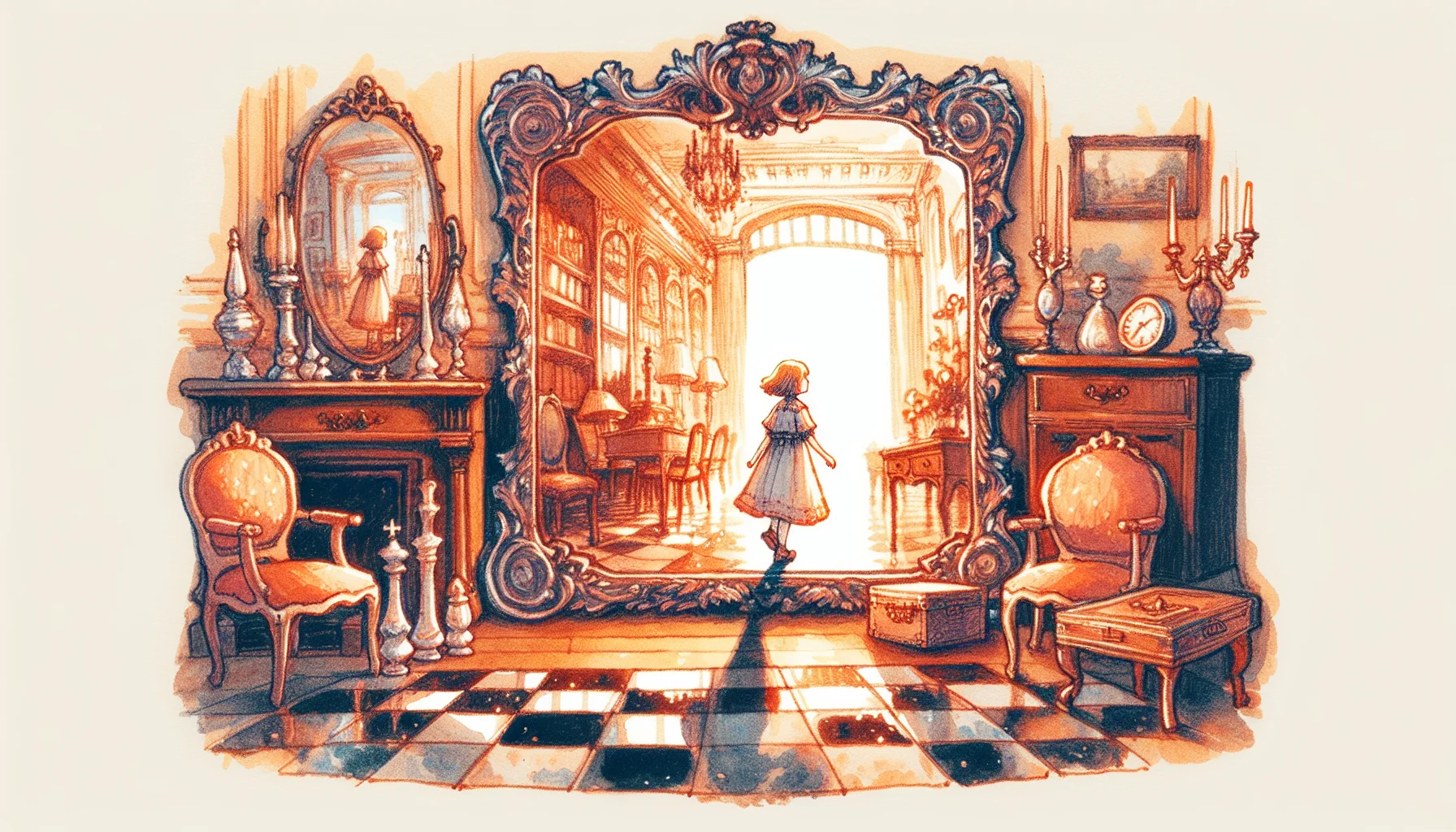
Most families who loved Alice in Wonderland don't realize there's a sequel, or they've heard of it but never actually read it. Through the Looking-Glass is Carroll's 1871 follow-up, written six years after the first book and aimed at the same audience. It is in many ways a richer story, and it benefits enormously from being read aloud.
The setup is simple: Alice steps through a mirror above the fireplace and finds herself in a reversed world organized like a chess game. From there, Carroll does what he did in Wonderland, but with more structure and more poetry. The book contains two of the most famous pieces of nonsense verse in the English language, and hearing them read out loud is a completely different experience from reading them on the page.
Because fewer families are familiar with this one, it has the feeling of a genuine discovery rather than a revisit. That makes it a particularly good choice for a second audiobook project.
What to expect
The full text runs about 60 minutes of audio, spread across 12 chapters. That makes it slightly longer than the first Alice book, but the chapter structure is similar and it sits comfortably at one chapter per night. Ages 7 through 10 are the target range, though the book's more elaborate wordplay rewards older listeners more than the first book does.
The tone is playful but also a little more melancholy than Wonderland. Carroll was older when he wrote it, and there are moments where the strangeness has a bittersweet edge. Children don't usually pick up on this, but adult narrators often do, and it can make the recording feel warmer and more personal.
Why it works at bedtime
Like Wonderland, the chapters here are self-contained scenes. Alice moves across a chess board, meeting characters at each square, and the structure has the natural pausing points that bedtime reading needs. You rarely end a chapter mid-tension.
"Jabberwocky" appears in chapter one and it is almost always a hit. Children ask to hear it again. The nonsense words ("brillig," "slithy toves," "vorpal blade") settle into a child's memory in a way that real words often don't, and they tend to quote them back at breakfast the next morning. The Walrus and the Carpenter, which appears later as a poem-within-the-story, has a darker undertone that older children find interesting once they think about what it actually means.
The chess structure gives the whole book a sense of forward motion. Alice is moving toward becoming a Queen, and children understand that as a goal even if they don't follow the chess logic. It makes the book feel like it's going somewhere, which Wonderland sometimes doesn't.
Recording it
Two minutes of voice recording is what we need to produce the complete audiobook in your voice. You can record on a phone in any quiet room. No special equipment or experience required.
The poems are worth noting for narrators. "Jabberwocky" and "The Walrus and the Carpenter" are long enough that they feel like a natural place to slow down and enjoy the rhythm. If you read them a little more deliberately than the surrounding prose, they land better. Carroll's meter is strong and the verse essentially carries itself.
Humpty Dumpty is the character most narrators have the most fun with. He is pompous and certain and wrong, which is a very satisfying combination to voice. Tweedledee and Tweedledum are also crowd-pleasers, especially their recitation of the Walrus and the Carpenter poem.
A note on this version
Because this book is less culturally prominent than Wonderland, almost everything in it will be new to the child. There is no film version that has fixed the characters in people's minds, no widely reproduced illustration everyone has seen. That gives the narrator's voice more room. The child has no competing image to reconcile.
The book also ends on a more reflective note than Wonderland. Alice wonders which of the characters she met was real and which was her dream. Carroll doesn't answer the question, and children often want to discuss it. That kind of ending, where the story keeps going a little after it stops, tends to produce good conversations.
Families who have already done Alice in Wonderland will find this one rewards the comparison. Characters cross over, themes recur, and children who remember the first book will feel like they're returning to a world they know rather than starting over in a new one.