The Tin Woodman of Oz: What Does It Mean to Have a Heart?
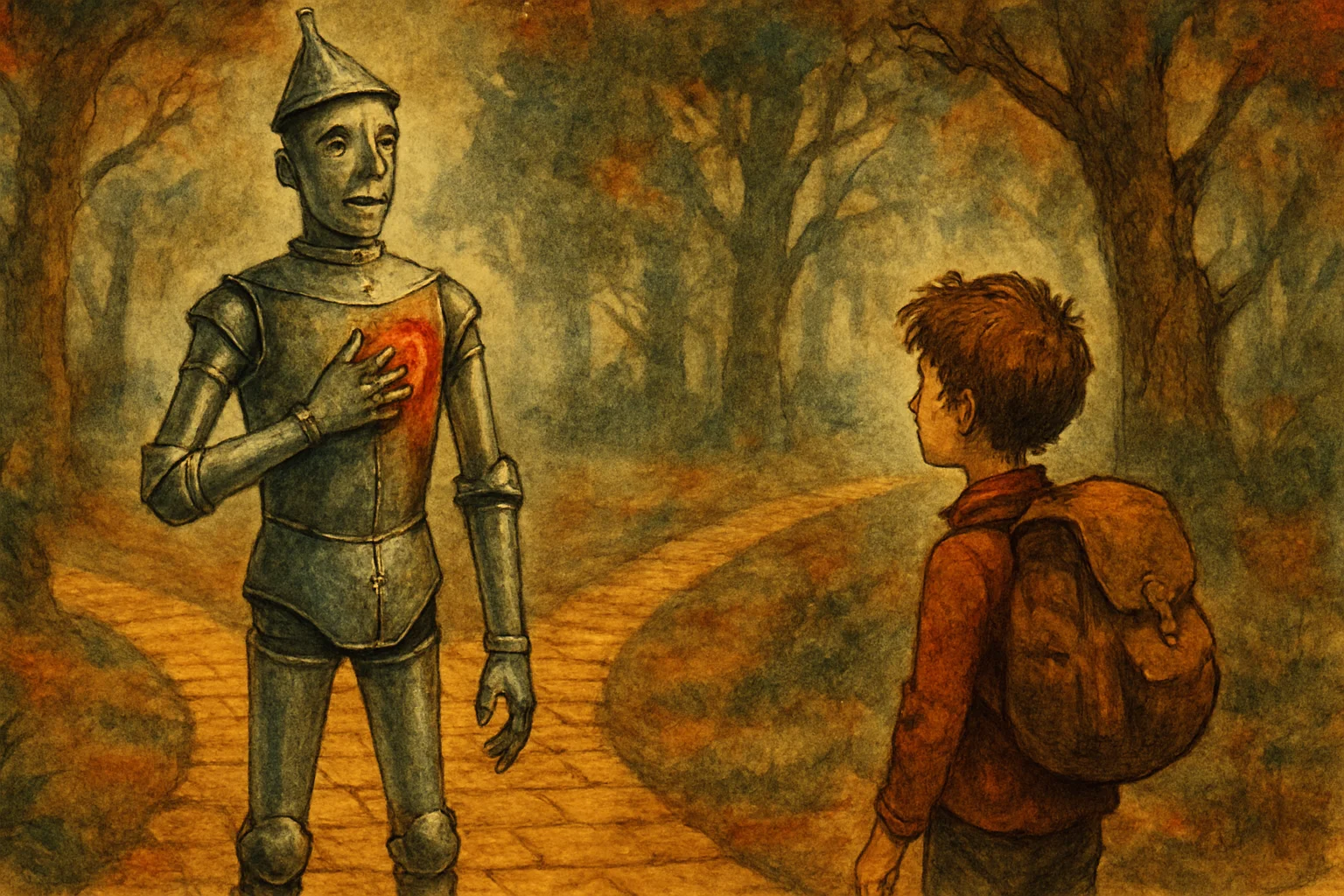
The Tin Woodman of Oz, published in 1918, is the twelfth book in the series and by a considerable distance the most philosophical. It is also, in its quiet way, one of the most unsettling — not because it is frightening, but because it asks questions that genuine answers do not easily resolve. The central question was always latent in Nick Chopper's story: if you replaced your heart with a tin one, did you still feel what you used to feel? Baum spent the first book sidestepping this. Here he walks straight toward it.
The old love and the new quest
Woot the Wanderer, a young boy who has been wandering Oz without destination, arrives at the Tin Castle and sits down to dinner with Nick Chopper and the Scarecrow. After some conversation, Woot innocently asks: whatever happened to Nimmie Amee, the Munchkin girl the Tin Woodman loved before the Wicked Witch's enchanted axe took away all his flesh? Nick Chopper — the Emperor of the Winkies, ruler of a tin palace, proud owner of a heart stuffed with kindness — realizes with some embarrassment that he has not thought about Nimmie Amee in years. Woot suggests that a kind man with a heart full of love ought to go find her. Nick Chopper agrees. And so they set off.
The Scarecrow comes along because he always does. They are joined along the way by Polychrome (the Rainbow's daughter, drifting earthward again) and Captain Fyter, a tin soldier who turns out to have also loved Nimmie Amee, been enchanted by the same Wicked Witch, and lost his flesh parts to a different tinsmith's clever replacements. The party becomes a small philosophical seminar on identity, continuity, and what exactly it is that loves when you love someone.
Mrs. Yoop the Giantess
The road is interrupted by Mrs. Yoop, a Giantess and accomplished Yookoohoo — a practitioner of a particular brand of transformation magic. She captures the travelers and transforms them into various animals and objects for her own amusement: Nick Chopper becomes a tin owl, the Scarecrow becomes a straw-stuffed bear, and so on. The transformations are played for comedy, but there is an edge to them too. When you have already spent several chapters thinking about what makes you yourself, being turned into something else raises the stakes in a way Baum clearly intends. Woot, watching his companions waddle around transformed, thinks very carefully about identity. Children listening will too, without necessarily being able to name what they're thinking about.
The punchline at the end of the road
When the travelers finally find Nimmie Amee — which takes considerable doing — they discover that she has married. Her husband is named Chopfyt. And Chopfyt, it emerges, was assembled by their tinsmith from the flesh parts of both Nick Chopper and Captain Fyter — the original human hands, arms, and head that the enchanted axe had cut away, reused to make a new man. Nimmie Amee, thoroughly practical, decided that having a man partly made of the two tin men she once loved was near enough. She seems quite content.
Baum plays the scene with a light touch — it is comedy, not tragedy, and nobody's feelings are seriously hurt. But the philosophical implication is extraordinary for a children's book. If your original body fell in love with someone, and then your replacement body went looking for her and found someone made from your original body who she preferred — who is the real you? Who really loved her? The Scarecrow and Nick Chopper discuss this on the road home with the same cheerful inconclusivenss they bring to everything, and it is one of Baum's finest moments.
Why it works at bedtime
At about sixty minutes, The Tin Woodman of Oz is pitched at slightly older children than most Oz books — the jokes land at ages seven and up, and the philosophical undercurrent will reward children of ten or eleven with something genuinely worth discussing the next morning. The adventure sections are entertaining in themselves, and Mrs. Yoop's transformations are funny enough to sustain listeners who are not yet quite tracking the deeper questions. But the conversations between the Scarecrow and the Tin Woodman — two characters who have been asking versions of the same question since book one — have a warmth and depth that is rare in children's fiction of any era.
Do I need to read the earlier books first?
Yes, more than most. The emotional weight of this book depends entirely on knowing Nick Chopper's backstory from The Wizard of Oz, and the resonance of the ending depends on having grown attached to the Tin Woodman over the course of the series. The Scarecrow and Tin Woodman's friendship, built across twelve books, is what gives their philosophical road-trip conversations their warmth. This is a book for dedicated series readers, and it rewards them generously.