Sleeping Beauty: A Bedtime Guide for Parents
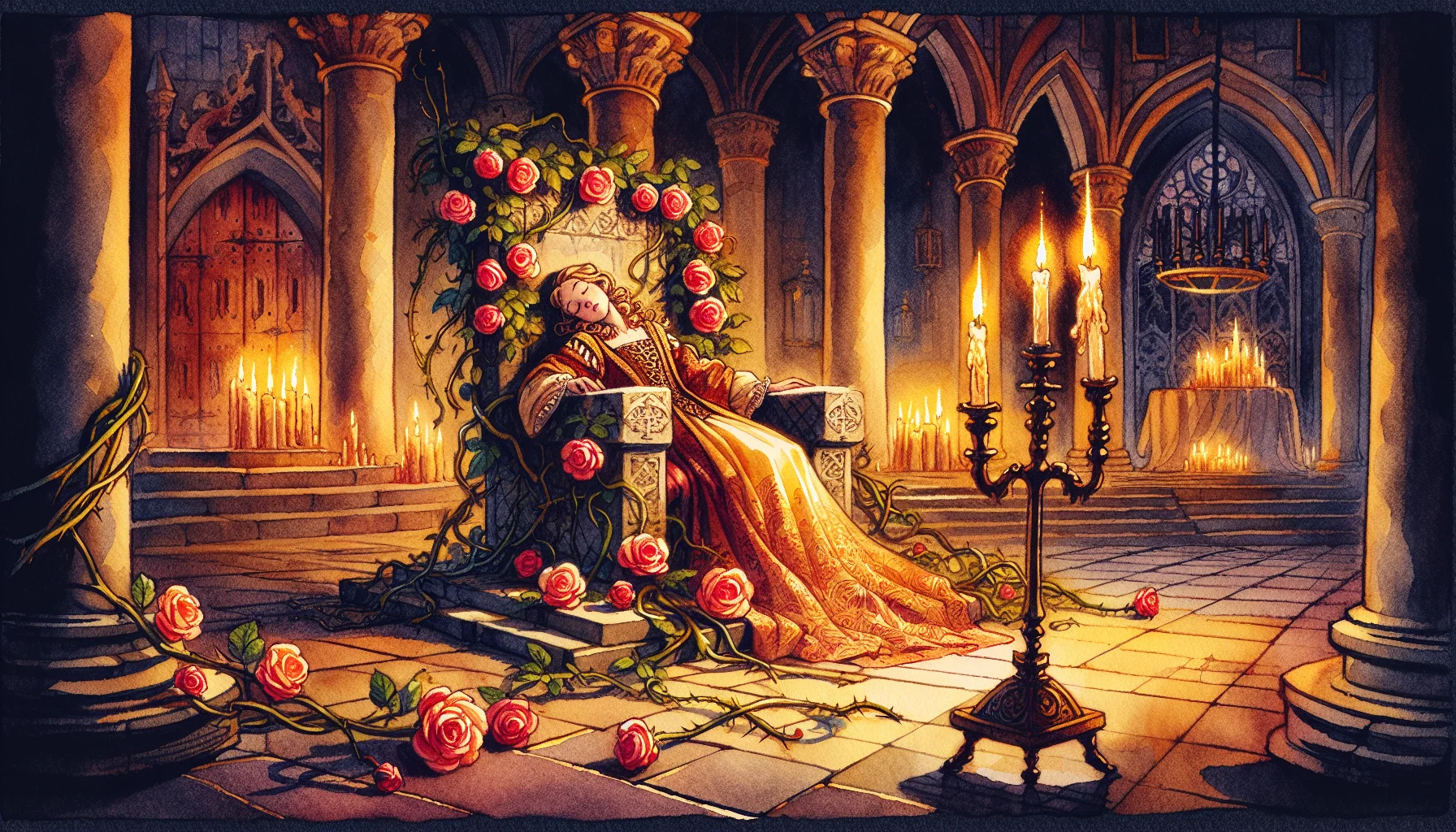
Sleeping Beauty, known as Briar Rose in the Grimm's version, is the story of a princess cursed at birth to prick her finger on a spindle and fall into a sleep that will last a hundred years. The king has every spindle in the kingdom destroyed, but inevitably, on the princess's fifteenth birthday, she finds the one that was missed. She falls asleep, and the whole castle falls asleep with her.
At its heart this is a story about a curse no one can quite outrun, about waiting, and about the moment the world wakes back up. It is one of the most dreamlike of all the classic fairy tales, quiet, almost hypnotic in the way it is told. A briar hedge grows up around the sleeping castle, and prince after prince fails to break through until, a hundred years later, one finally does.
For very young children, this quality of the story is actually an asset at bedtime. It is not exciting in the way that Hansel and Gretel is exciting. It is slow and warm and lulling, and children often drift off before it ends. That is not a failure. That is the story doing its job.
What to expect
This is the shortest story in the catalog at about 12 minutes. It suits ages 3 to 7 well, and is particularly good for the younger end of that range. Children who are not yet ready for the more intense Grimm's stories, the witch in the forest, the poisoned apple, tend to do well with this one. There is a curse, and there is a villain (the wise woman who casts it), but the peril is abstract. No one is chased. No one is in immediate danger once the princess falls asleep.
The tone is closer to a lullaby than an adventure. Events unfold with a kind of inevitability that is more soothing than suspenseful. Young listeners follow it easily because it is so clear: here is the problem, here is the wait, here is the solution.
Why it works at bedtime
The pacing slows naturally as the story progresses. The kingdom goes to sleep. The castle goes quiet. The briar hedge grows. By the time the prince arrives, the story has been in this suspended, still state for several minutes, and the child listening has usually followed it there.
The ending is gentle and complete. The princess wakes, the prince is there, the whole castle wakes up and life resumes. There is no villain left standing, no unresolved trouble. It ends with warmth, not drama. Children who are not already asleep by that point tend to be very ready to be.
Recording it
Sleeping Beauty is an easy recording assignment, possibly the easiest in the catalog. It is short, the language is simple and flowing, and there are no difficult names or tricky passages. It is a good choice for grandparents or parents who feel nervous about the recording process, this one feels natural from the first take.
The recording is about 2 minutes of your own voice. You do not read the story yourself; Classic Kid Lit uses your 2-minute sample to produce the full narration in your voice. The finished audiobook is delivered in a few days and can be replayed as often as the child wants.
A note on this version
The Grimm's version, titled "Briar Rose," ends when the prince wakes the princess. That is where the Disney film ends too, so for most families the story will feel familiar all the way through.
An older French version by Charles Perrault, the one predating the Brothers Grimm, continues past the wedding into a second half involving the prince's ogress mother, who tries to eat Briar Rose and her children. The Grimm's version cuts all of that, and so does this audiobook. What remains is the clean, classic arc that most people know and love: the curse, the sleep, the waking. Nothing unsettling is left in.