The Scarecrow of Oz: A Frozen Heart and a Gardener's Boy
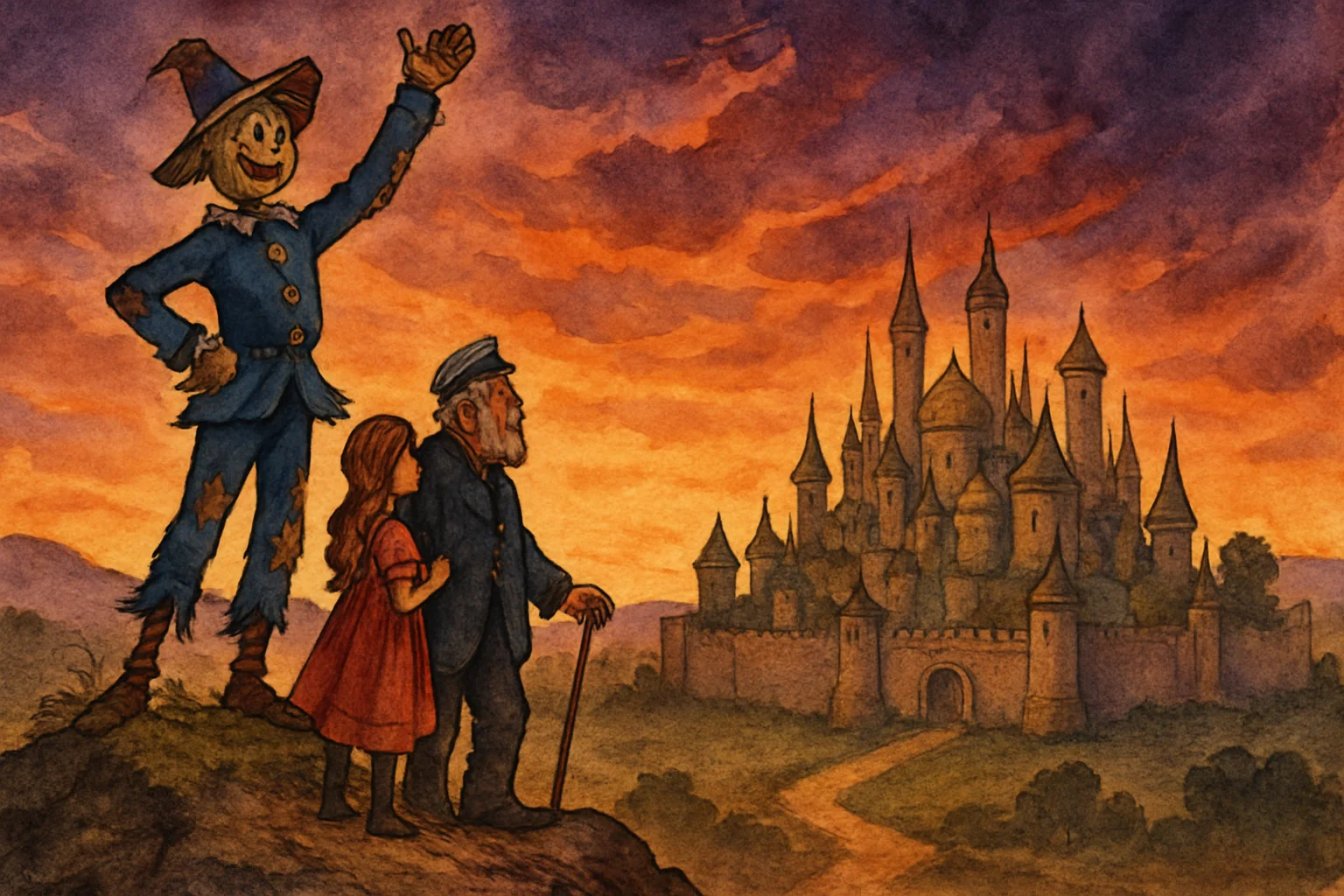
There is something almost Shakespearean about the central predicament of the ninth Oz book. A princess cannot love the boy she loves because a wicked witch — hired by a king who wants her to marry someone richer — has literally frozen her heart. She walks through her days perfectly pleasant, perfectly polite, and perfectly incapable of feeling anything. It is a children's story, but Baum understood that children are not strangers to the peculiar hurt of being told that the love they feel is wrong, too small, or pointed in the wrong direction. The Scarecrow of Oz, published in 1915, wraps that theme in a whirlpool adventure, underground caverns, and one of the most satisfying rescues in the entire series.
Down the whirlpool and through the caves
We arrive in Oz this time with Trot, a sharp, practical girl from the California coast, and Cap'n Bill, her companion — a retired sailor with a wooden leg, a slow drawl, and a great deal of calm good sense. Baum had invented them two years earlier for a non-Oz fantasy called The Sea Fairies, and he liked them enough to bring them along for the ride. They fall into a whirlpool while out on the water and spend the early chapters working their way through a series of underground kingdoms, each more peculiar than the last. The underground journey has a slightly dream-like quality — small kingdoms governed by absurd rules, characters who have forgotten entirely that a larger world exists above them — and it eases young listeners into the story's stranger emotional territory before Oz itself arrives.
King Krewl and the hired witch
The villain here is King Krewl of Jinxland — a petty, vain, thoroughly unpleasant man who has decided that Princess Gloria should marry a wealthy lord named Googly-Goo rather than Pon, the gardener's boy she actually loves. Unable to simply forbid it (love, inconveniently, does not respond to royal decrees), Krewl hires a witch named Blinkie to freeze Gloria's heart. It works. Gloria becomes coldly indifferent to Pon, to Krewl, to everything — a kind of magical depression rendered with more fidelity than you might expect from a 1915 children's book. Baum's take on class is embedded in the choice of villain: it is not that Pon is unworthy, it is that someone wealthy and powerful has decided he is. The injustice is clear even to the youngest listener.
The Scarecrow's finest hour
The title is a little misleading — the Scarecrow does not appear until the second half of the book, when Trot and Cap'n Bill finally reach Oz and Ozma sends him south to sort out the trouble in Jinxland. But his arrival is worth the wait. Armed with Ozma's magic, he thaws Gloria's frozen heart, deposes Krewl with minimal fuss, and reunites Gloria and Pon with a quiet efficiency that makes the emotional payoff feel earned rather than easy. The Scarecrow is at his best when he is solving problems with a combination of good sense and magic — this is one of those moments.
What Baum seems to understand, and what gives the scene its warmth, is that thawing a frozen heart is not the same as healing a broken one. Gloria does not simply snap back; she has to rediscover what she felt. It is a small but real distinction, and children who have experienced any kind of emotional numbness — even just the aftermath of a bad day — will recognize something true in it.
Why it works at bedtime
The Scarecrow of Oz runs about sixty minutes, which makes it a generous week of bedtime listening. The pace is carefully constructed: the underground adventure sections are episodic and fun, each little kingdom offering something new to laugh at, and then the emotional weight of Gloria's story arrives when the listener is already settled into the world. Trot is a wonderful guide — she never loses her nerve, she asks sensible questions, and she says what she thinks without being preachy about it. Cap'n Bill provides a perfect counterbalance: steady, unhurried, unflappable. Children who tend toward anxiety will find something comforting in how calmly he takes each new strangeness.
Do I need to read the earlier books first?
The Scarecrow of Oz is one of the more self-contained books in the series. Trot and Cap'n Bill are new characters, and Baum introduces the Oz setting naturally through their eyes. The Scarecrow is re-introduced when he arrives; you don't need his backstory to appreciate him here. If your child has already heard The Wizard of Oz or The Patchwork Girl of Oz, they'll have a richer sense of the world, but this book is genuinely accessible on its own. It is, if anything, a good entry point for a child who is not sure they want to commit to a long series — the story is complete, the ending is satisfying, and they can decide afterwards whether they want more.