Pinocchio: What Parents Need to Know About the Original 36-Chapter Story
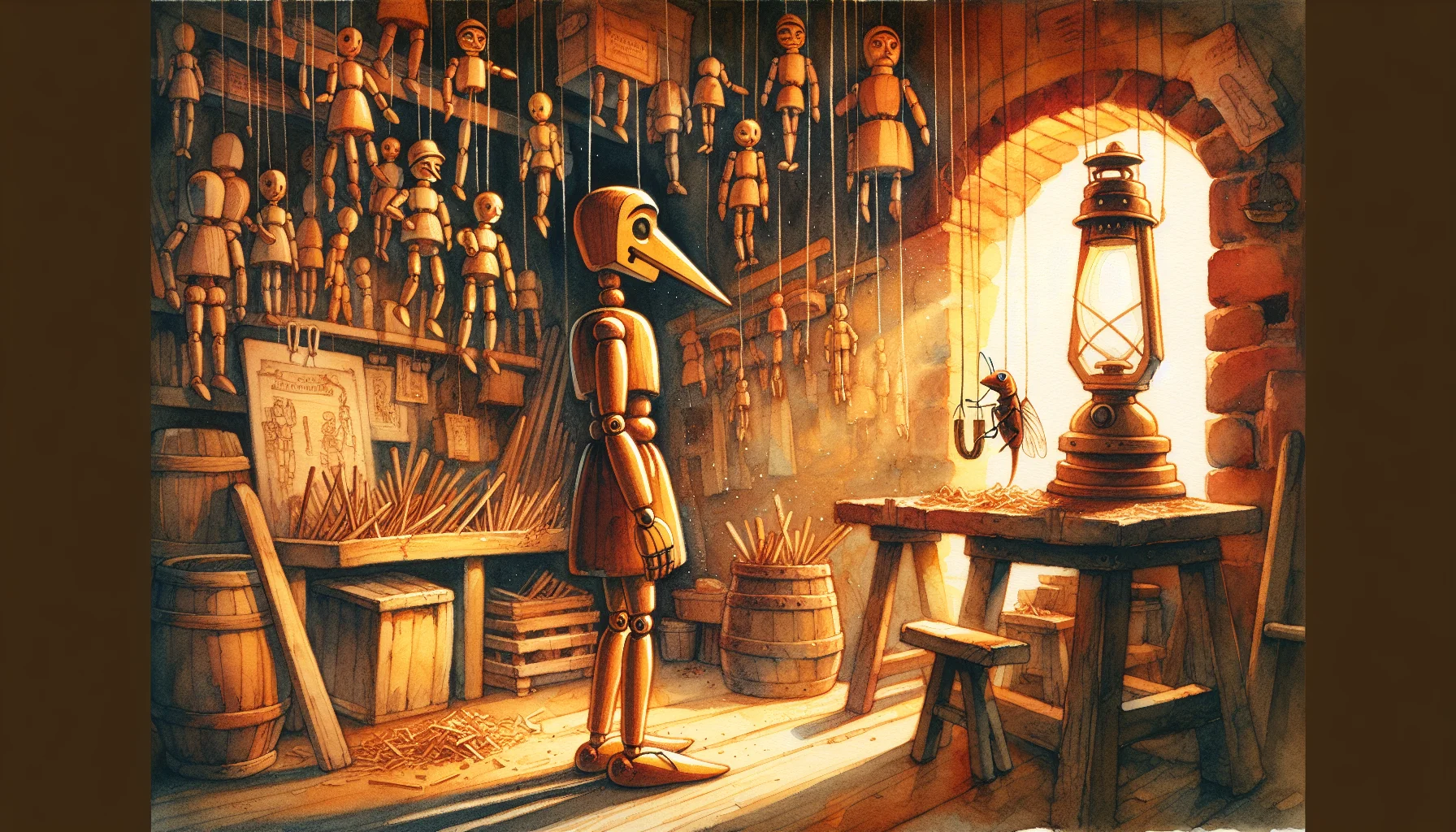
Carlo Collodi published "The Adventures of Pinocchio" in serial form between 1881 and 1883 in an Italian children's newspaper. He wrote it reluctantly at first, and that tension between duty and mischief is in the book. Pinocchio is not a lovable scamp who wants to do right. He is impulsive, selfish, and repeatedly catastrophic, and yet the story does not punish him for being a child. Geppetto builds him and loves him, and Pinocchio spends 36 chapters failing and recovering and failing again, until he finally earns the thing he wanted most.
The story is structured like a picaresque novel, one misadventure after another, each with its own logic and consequence. Pinocchio gets tricked by a fox and a cat. He falls in with bad company and turns into a donkey. He ends up inside a whale (not a whale in the Disney sense, a shark the size of a mountain, called "The Terrible Shark"). Every chapter ends with Pinocchio in a worse situation than he started, which is how children's serial fiction worked in 1881, and it still holds attention the same way.
The complete book runs approximately three hours. Families typically do one or two chapters per night over several weeks. At that pace, it becomes something different than a bedtime story, it becomes a running world that a child lives inside for a month or more, waiting each night to find out what Pinocchio does next.
What to expect
Pinocchio is best for ages 6 and up. Younger children can follow it, but the chapter-a-night structure works better for kids old enough to hold the narrative across multiple sessions without losing track of where they are.
Total runtime is approximately three hours across all 36 chapters. Each chapter runs roughly five to eight minutes, which makes the chapter-a-night format practical. Two chapters is a reasonable extended session for kids who are engaged and not yet ready to sleep.
The tone shifts more than you might expect. Some chapters are genuinely funny, Pinocchio's interactions with the talking cricket, the ridiculous logic of the Land of Toys. Others are darker. The story does not maintain a consistent emotional register, which keeps it from becoming predictable. Children who are old enough to handle a range of tones will find that variety compelling.
Why it works at bedtime
Each chapter has its own complete arc. Something starts, something happens, and it resolves (usually badly for Pinocchio) by the end. That structure means children get a satisfying stopping point every night without the story feeling chopped up. They know where they are, and they know something new will happen tomorrow.
The cumulative effect is significant. By the halfway point, children are genuinely invested in whether Pinocchio will figure things out. The failures stop being funny and start feeling consequential. The last few chapters, when he finally commits to something real, land harder because of everything that preceded them.
For deployed parents especially, this structure is practical. At one chapter per night, the book lasts six weeks. At two chapters, about three weeks. A parent who leaves on a six-month deployment and starts this audiobook with their child the week before shipping out has a story that can go the full distance and beyond, something for the child to return to, pause, and continue as needed.
Recording it
The Pinocchio audiobook is $95. That reflects the full 36 chapters, roughly three hours of narration produced from your two-minute voice sample.
For deployed parents, the recording is often done before departure. Two minutes of natural speech is all we need. Read a paragraph aloud, tell us something about your day, say a few sentences to your child, whatever is comfortable. We match the voice from that and build the full production.
The length of the story is actually an advantage here. A short story is a single gift. Pinocchio is a commitment, a parent's voice showing up every night for weeks, telling a story chapter by chapter, as if they were there in the room. Children who have listened to a Pinocchio audiobook from a deployed parent describe it the same way: it felt like being read to, not like listening to a recording.
Geppetto is in most chapters, which means the child hears a parent's voice playing a father who loves an impossible kid with his whole heart. That parallel does not go unnoticed, even by young children.
A note on this version
Disney's 1940 film is one of the greatest animated films ever made, and it has almost nothing to do with Collodi's book beyond the broad outline.
In the original, Pinocchio kills the talking cricket with a hammer in chapter four. The cricket returns as a ghost to offer more advice. Pinocchio ignores that too. In chapter fifteen, Pinocchio is hanged from an oak tree and left for dead. That chapter was actually the intended ending when Collodi wrote it as a serial, readers demanded more, so he continued. None of this is graphic in the way it sounds; Collodi writes it with the same deadpan logic as everything else. But it is considerably darker than the Disney version, and parents should know before they start.
The Disney film is gentle and beautiful. Collodi's book is funnier, stranger, and more honest about how children actually behave when no one is watching. Both are worth experiencing. They are telling different stories about the same puppet.